
Showing posts with label International. Show all posts
Showing posts with label International. Show all posts

Hurricane Irma killed one person and left behind “total devastation” as the monster storm smashed into the tiny Caribbean island of Barbuda on Wednesday, the prime minister said.
“It is just total devastation, Barbuda now is literally rubble,” Prime Minister Gaston Browne said in the aftermath of the Category Five storm.
Speaking later on CNN, Browne said 95 percent of properties in Barbuda were damaged, with up to 30 percent demolished.
“It is absolutely heart-wrenching,” he said.
One person is known to have died, Browne said, apparently to be child whose mother was taking him or her to safety after the building they were in was damaged.
The airport was damaged and flights were unable to land. Badly-needed aid will have to be flown in by helicopter from Antigua, he added.
“We have estimated the rebuilding efforts to be no less than $100 million. That is conservative, because we’re talking about rebuilding everything, all of the institutions, the infrastructure, the telecommunications, the roads… Even the hotels on the island, those are totally demolished, as well. It is terrible.”
Located east of Puerto Rico, Barbuda has 1,600 residents and is the sister island of Antigua, which was spared the worst of the storm.
Total Devastation’ As Irma Hits Caribbean Island Barbuda
 If the U.S. attacks North Korea, the world could see another nuclear war. Yet negotiations won’t work leader Kim Jong Un won’t live up to his promises even if he were to make any. And China if only it would help more!
Those sentiments have produced a collective shrug from many as they watch the North make rapid strides toward developing nuclear missiles capable of striking anywhere in the United States.
But Washington hasn’t tried everything yet.
Below, three experts offer ideas on how the U.S. might get out of its policy box on North Korea.
And none of them require firing a shot.
Deterrence — A familiar game for U.S.
Vipin Narang
Deterrence is about making sure your opponent has no good military moves. Kim Jong Un has proven to be pretty good at it.
Vipin Narang, a nuclear strategy and nonproliferation expert at the Massachusetts Institute of Technology, believes U.S. policymakers need to let that sink in.
“Saying that this nuclear program has not augmented or improved North Korea’s ability to deter particular actions, especially regime change or invasion or disarmament, is simply denying reality and putting our head in the sand,” he said.
The good news is deterrence is a game the United States has played before.
“We know how to do this,” he said. “We did it with China and the Soviet Union and managed to reassure West Germany and Europe during the Cold War. There is no logical reason we cannot do it with North Korea. Kim is not crazy or irrational and responds to strategic and domestic incentives.”
Upping the game will require two things Narang believes are now lacking- a coherent and unified message to Pyongyang from President Donald Trump’s administration, and strong, believable reassurances to America’s regional allies.
Along with preventing a U.S. attack, North Korea’s nuclear weapons and missile tests are intended to create discord among the U.S., Japan and South Korea and, though it’s not an American ally China. If America’s ability to handle North Korea is in doubt, there is more pressure for South Korea and Japan to pursue independent strategies and even consider developing nuclear weapons of their own.
Moreover, the different messages coming from the White House, State Department and Department of Defense ranging from Trump threatening “fire and fury” to the more conciliatory tone of Secretary of State Rex Tillerson Pyongyang has more incentive to push ahead quickly to either take advantage of what it sees as weakness or bolster its capabilities ahead of what it fears to be a looming invasion.
“So long as this incoherence persists, it becomes very difficult to craft deterrent positions clearly and effectively,” Narang said. “At this point, the way forward it seems to me is to always keep the channel for negotiations open while simultaneously practicing deterrence and reassurance to our allies.”
And maybe one more thing. Tone down the tweets.
“When President Trump tweets the day after the alleged H—bomb test that South Korea should stop ‘appeasement’ of North Korea, Pyongyang can be nothing short of delighted at its strategy working,” Narang said.
Not China’s job
Joel Wit
Previous efforts to get North Korea to give up its nuclear weapons have leaned heavily on Beijing, and to a lesser extent Moscow, to enforce sanctions and apply political pressure. It’s an approach Trump seems to support wholeheartedly. Right after the North’s nuclear test Sunday, he tweeted that Pyongyang has become “a great threat and embarrassment to China, which is trying to help but with little success.”
But China’s and Russia’s national interests aren’t the same as Washington’s. Shifting the onus to them for a solution diminishes U.S. leadership and control, said Joel Wit, a senior fellow at the Johns Hopkins’ School of Advanced International Studies and a former State Department official who developed strategies to deal with the crisis over North Korea’s weapons program in the 1990s.
“Under the best of circumstances, China can play a supporting role, both in supporting limited pressure on the North and in supporting diplomatic outreach to Pyongyang,” he said. “But it has not and will not do what Washington wants solve this problem for the United States by creating overwhelming pressure.”
Even if Beijing went along, Wit said it still wouldn’t work- “The North Koreans are not going to roll over and play dead when faced with an existential threat to their regime. They will lash out.”
Wit also said the Trump administration will have “virtually no prospect of securing Chinese cooperation” if it insists that reining in North Korea is mainly a Chinese problem. He believes North Korea is already taking advantage of the growing split between Washington and Beijing to “sprint to the WMD (weapons of mass destruction) finish line.”
“The idea that this is the land of no good options leads everyone to move on,” he said. “Almost every foreign policy challenge facing the U.S. could be called the same thing. But this fatalistic attitude has permeated U.S. policy for over a decade and has led us to where we are today.”
The art of the deal
John Delury
If the U.S. is going to get what it wants, it has to know what it wants. And it will probably need to give up something to get it.
John Delury, an associate professor of Chinese studies at Yonsei University in Seoul, believes the most realistic path forward involves three steps- “dialogue, negotiation, settlement.”
“Without talking to Kim Jong Un or his senior advisers, we just don’t know who we are dealing with, what their positions are, what we can give them that they really want, and what we can get in return. That moves us into the negotiation, for short—term steps that reduce risks, decrease hostility, even build a little confidence.”
Washington’s focus should be clear and specific. Negotiators should push for a missile and nuclear test moratorium, a freeze on the production of nuclear weapons, the return of nuclear inspectors and increased transparency. There must also be nonproliferation commitments.
Delury stresses there must also be some give and take.
“For these things, things that are in U.S. interests, the Trump administration, in close consultation with Seoul and Tokyo, will have to consider what it is willing to do, or forego,” he said.
Pyongyang says it wants some sort of security guarantee and the removal of the U.S. nuclear threat from the Korean Peninsula. Neither would seem to be a good starter topic, but another item on Pyongyang’s list scaling back or canceling the U.S. military’s annual wargames with the South might be an area the two could at least talk about.
In the longer term, Delury says, the U.S. must directly address “the true heart of the matter, which is working on a political settlement” that fundamentally transforms the U.S.—North Korea relationship.
“Let’s call those ‘peace talks,’ for lack of a better phrase,” he said.
Technically, the countries have remained at war since 1953, when an armistice rather than a peace treaty ended fighting in the Korean War.
Delury said negotiations “should also involve a heavy dose of economic cooperation, since the only alternative to the status quo that might appeal to Kim Jong Un is a North Korea that is not only secure, but also prosperous.”
The hope is that more political and economic engagement would over time prompt the North to ease its authoritarian controls. But the negotiation process would undoubtedly be fraught with ambivalence and resistance on both sides.
“It’s true there are no easy answers, no quick fixes, no silver bullets,” he said. “Even if we made a determined effort to improve the relationship, it would be hard and slow going.
“So being realistic about dealing with North Korea is prudent. But the current level of fatalism is counterproductive to coming up with a better approach.”
How Can U.S. Stop North Korea Nukes?

Amid international uproar over North Korea’s latest and biggest nuclear weapons test, one of its top diplomats said on Tuesday it was ready to send “more gift packages” to the United States.
Han Tae Song, Ambassador of the Democratic People’s Republic of Korea (DPRK) to the UN in Geneva, was addressing the UN-sponsored Conference on Disarmament two days after his country detonated its sixth nuclear test explosion.
“The recent self-defence measures by my country, DPRK, are a ‘gift package’ addressed to none other than the U.S.,” Mr. Han told the Geneva forum.
“The U.S. will receive more ‘gift packages’ from my country as long as its relies on reckless provocations and futile attempts to put pressure on the DPRK,” he added without elaborating.
“Pressure or sanctions will never work on my country,” Mr. Han declared, adding: “The DPRK will never under any circumstances put its nuclear deterrence on the negotiating table.”
North Warns Of More ‘Gift Packages’ For U.S.
 Prime Minister Narendra Modi on Wednesday met Myanmar’s State Counsellor Aung San Suu Kyi and the two leaders discussed ways to further cement the bilateral relations.
“Prime Minister Modi and Councillor Aung San Suu Kyi meet in Myanmar, discuss further cementing of India-Myanmar relations,” PMO said in a tweet.
“Meeting a valued friend. Prime Minister Modi with the State Councillor Aung San Suu Kyi,” External Affairs Ministry spokesperson Raveesh Kumar tweeted.
The Prime Minister’s visit to Myanmar comes amid a spike in ethnic violence with Rohingya Muslims in the Rakhine state. He is expected to raise the issue of the exodus of the ethnic Rohingyas into neighbouring countries.
The Indian government is also concerned about Rohingya immigrants in the country, and has been considering to deport them. Around 40,000 Rohingyas are said to be staying illegally in India.
India and Myanmar were also looking at strengthening existing cooperation in areas of security and counter-terrorism, trade and investment, infrastructure and energy, and culture, Mr. Modi had said ahead of his visit.
Mr. Modi arrived here on the second leg of his two-nation trip during which he travelled to southeastern Chinese city Xiamen where he attended the annual BRICS summit and held talks with Chinese President Xi Jinping, Russian President Vladimir Putin and other world leaders.
This is Mr. Modi’s first bilateral visit to Myanmar. He had visited the country in 2014 to attend the ASEAN-India Summit. The Myanmarese President and Ms. Suu Kyi had visited India last year.
Myanmar is one of India’s strategic neighbours and shares a 1,640-km-long border with a number of northeastern states including militancy-hit Nagaland and Manipur.
Modi Meets Suu Kyi, Discusses India-Myanmar Relations

Price could decide the fate of a product in developing and price-sensitive markets like India. This is why almost all smartphone manufacturing companies are trying to woo consumers in these countries by offering feature-rich devices at reasonable prices.
You may ask why so much focus in developing economies and not in developed economies; well the fact is that smartphone market in the former has good scope for growth while it is saturated in the former. So, it doesn’t come as a surprise to see dozens of budget and mid-budget smartphones from the Xiaomi Redmi Note 4 to Lenovo K8 Note, to Micromax Canvas Infinity currently available for purchase in Indian market.
Well, Indian consumers have the luxury of choosing the handset of their choice from a long line of smartphones but it can confuse some. So, here we bring you a select few that you can buy in September 2017. It may be mentioned that Xiaomi Redmi Note 4 is a few months old but it has made it to the list as it has done incredibly well in India, selling more than five million units in the first half of the year, and the best selling smartphone in the second quarter.
Xiaomi Redmi Note 4 specifications & price
Price: Rs 9,999 for 2GB RAM + 32GB storage model
Rs 10,999 for 3GB RAM+32GB storage model
Rs 12,999 for 4GB RAM+64GB storage model
Display: 5.5-inch IPS LCD capacitive touchscreen screen with 1,080×1,920 pixels (401 ppi pixel density)
Processor: Qualcomm Snapdragon 625
Operating system: Android Marshmallow (upgradable to Android 7.0 Nougat)
RAM: 2GB/3GB/4GB
Storage: 32GB/64GB (expandable up to128GB via microSD card)
Camera: 13MP main camera with BSI CMOS sensor, f/2.0 aperture, PDAF (Phase Detection Auto Focus), dual-tone LED flash and 1.12µm pixel size
5MP front snapper with f/2.0 aperture and 85-degree wide angle view of field
Battery: 4,100mAh
Micromax Canvas Infinity specifications & price
Price: Rs 9,999
Display: 5.7-inch IPS LCD capacitive touchscreen with 720×1,440 pixels (279 ppi pixel density)
Processor: Qualcomm Snapdragon 425
Operating system: Android 7.1.2 Nougat
RAM: 3GB
Storage: 32GB (expandable up to128GB via microSD card)
Camera: 13MP main camera with f/2.0 aperture, autofocus, LED flash, 1/3″ sensor size, 1.12 µm pixel size
16MP front-snapper with f/2.0 aperture, autofocus, LED flash
Battery: 2900mAh
Smartphones You Can Buy In September 2017: Redmi Note 4, Lenovo K8 Note, Micromax Canvas Infinity
 South Korean warships conducted live-fire exercises at sea on Tuesday as Seoul continued its displays of military capability following U.S. warnings of a “massive military response” after North Korea detonated its largest-ever nuclear test explosion.
South Korea’s presidential office also said Washington and Seoul have agreed to remove bilaterally agreed warhead restrictions on South Korean missiles, which would allow the South to develop more powerful weapons that would boost its pre-emptive strike capabilities against the North.
The South’s military exercises on Monday involved F-15 fighter jets and land-based ballistic missiles simulating an attack on North Korea’s nuclear test site to “strongly warn” Pyongyang over the recent detonation.
The heated words from the United States and the military maneuvers in South Korea are becoming familiar responses to North Korea’s rapid, as-yet unchecked pursuit of a viable arsenal of nuclear-tipped missiles that can strike the United States. The most recent, and perhaps most dramatic, advance came on Sunday in an underground test of what leader Kim Jong Un’s government claimed was a hydrogen bomb, the North’s sixth nuclear test since 2006.
The U.N. Security Council held its second emergency meeting about North Korea in a week on Monday, with U.S. Ambassador Nikki Haley saying the North’s actions show that Mr. Kim is “begging for war,” and the time has come for the Security Council to adopt the strongest diplomatic measures.
“Enough is enough. War is never something the United States wants. We don’t want it now. But our country’s patience is not unlimited,” Ms. Haley said.
South Korea has been seeking to obtain more powerful missiles while it pursues a so-called “kill chain” pre-emptive strike capability to cope with North Korea’s growing nuclear and missile threat.
Since the late 1970s, South Korean missile developments have been limited by a bilateral “guideline” between the U.S. and South, and it was updated in 2012 to allow the South to increase the range of its weapons from 500 km (310 miles) to 800 km (497 miles).
The agreement revealed on Tuesday removes the 500-kg (1,100 pound) warhead limit on South Korea’s maximum-range missiles, which would free the South to develop more powerful weapons potentially targeting the North’s underground facilities and shelters.
In addition to expanding its missile arsenal, South Korea is also strengthening its missile defense, which includes the high-tech Terminal High Altitude Area Defense battery currently deployed in the southeastern county of Seongju.
On Tuesday, a 2,500-ton frigate, a 1000-ton patrol ship and 400-ton guided-missile vessels participated in drills off the eastern coast aimed at retaliating against potential North Korean provocations, the Defense Ministry said. The Ministry said more naval drills are planned from Wednesday to Saturday in the country’s southern seas.
The Ministry said on Monday that North Korea appeared to be planning a future missile launch, possibly of an ICBM, to show off its claimed ability to target the United States with nuclear weapons, though it was unclear when such a launch might happen. Ministry official Chang Kyung-soo told lawmakers that it was seeing preparations in the North for an ICBM test but didn’t provide details about how officials had reached that assessment. Mr. Chang also said the yield from the latest nuclear detonation appeared to be about 50 kilotons, which would mark a “significant increase” from North Korea’s past nuclear tests.
Each new North Korean missile and nuclear test gives the country’s scientists invaluable information that allows big jumps in capability. North Korea is thought to have a growing arsenal of nuclear bombs and has spent decades trying to perfect a multistage, long-range missile to eventually carry smaller versions of those bombs.
Both diplomacy and severe sanctions have failed to check the North’s decades-long march to nuclear mastery.
President Donald Trump, asked in Washington if he would attack North Korea, said, “We’ll see.” No U.S. military action appeared imminent, and the immediate focus appeared to be on ratcheting up economic penalties, which have had little effect thus far.
Mr. Trump in tweets earlier had threatened to halt all trade with countries doing business with North Korea, a clear warning to its patron and closest ally, China. Such a move would be radical since the U.S. imports about $40 billion in goods a month from China. Foreign Ministry spokesman Geng Shuang said China regarded as “unacceptable a situation in which on the one hand we work to resolve this issue peacefully but on the other hand our own interests are subject to sanctions and jeopardized. This is neither objective nor fair.”
In brief remarks after a White House meeting with Mr. Trump and other national security officials, Defense Secretary Jim Mattis told reporters that America does not seek the “total annihilation” of North Korea, but then added somberly, “We have many options to do so.”
Mattis also said the international community is unified in demanding the denuclearization of the Korean Peninsula and that Kim should know Washington’s commitment to Japan and South Korea is unshakeable.
Sunday’s detonation builds on recent North Korean advances that include test launches in July of two ICBMs. The North says its missile development is part of a defensive effort to build a viable nuclear deterrent that can target U.S. cities.
North Korea has made a stunning jump in progress in its nuclear and missile programs since Mr. Kim rose to power following his father’s death in late 2011. The North followed its two tests of Hwasong-14 ICBMs, which, when perfected, could target large parts of the United States, by threatening to launch a salvo of Hwasong-12 intermediate range missiles toward the U.S. Pacific island territory of Guam in August.
It flew a Hwasong-12 over northern Japan last week, the first such overflight by a missile potentially capable of carrying nuclear weapons, in a launch Mr. Kim described as a “meaningful prelude” to containing Guam, the home of major U.S. military facilities, and vowed to launch more ballistic missile tests targeting the Pacific.
Beyond the science of the blast, North Korea’s accelerating push to field a nuclear weapon that can target all of the United States is creating political complications for the U.S. as it seeks to balance resolve with reassurance to allies that Washington will uphold its decades-long commitment to deter nuclear attack on South Korea and Japan.
That is why some questioned Mr. Trump’s jab at South Korea when he tweeted that Seoul is finding that its “talk of appeasement” will not work. The North Koreans, he added, “only understand one thing,” implying military force might be required. The U.S. has about 28,000 troops stationed in South Korea and is obliged by treaty to defend it in the event of war.
S. Korea Continues Military Drills After N. Korean Nuke Test
 Cuba on Tuesday began a five-month political transition expected to end with Raul Castro’s departure from the presidency, capping his family’s near-total dominance of the country’s political system for nearly 60 years.
Over the rest of this month, Cubans will meet in small groups to nominate municipal representatives. Cuban officials say 12,515 block-level districts will nominate candidates for city council elections on October 22.
In the second electoral stage, a commission dominated by government-linked organisations will pick all the candidates for elections to provincial assemblies and Cuba’s national assembly.
The congress is expected to pick the president and members of the powerful Council of State by February. Mr. Castro has said he will leave the presidency by that date, though he is expected to remain head of the Communist Party.
Cuba Begins 5 Month Political Transition
 Vice President Mike Pence met with people reeling under the rampage caused by Hurricane Harvey in the US state of Texas and promised them of full support by his government until the state is back on its feet.
Mr. Pence along with several cabinet officials met the people in Corpus Christi yesterday before heading to the town of Rockport.
“The American people are with you,” he told a crowd outside a Rockport church that was damaged by the tropical storm.
“We are here today, we will be here tomorrow and we will be here every day until this city and this state and this region is rebuilt bigger and better than ever before,” he said.
Taking stock of the damage caused by catastrophic floods brough by Harvey, Mr. Pence vowed over and over that Washington will invest whatever it takes, for as long as it takes, to ensure a full recovery of the state.
“We promise you, we’re going to stay with you every step until we bring Southeast Texas back bigger and better than ever before,” he said.
About 21,000 federal workers have been mobilised in response to the storm and the Congress is expected to debate passage of a multi billion-dollar emergency aid package in the coming weeks.
Harvey, now a tropical depression, made the second landfall on Wednesday, slamming into the Louisiana coast near the Texas border hitting the region with record-breaking rainfall and devastating floods.
Harvey has brought the heaviest rainfall in US history, soaking Texas with more than 52 inches since it first made landfall last Friday.
At least 38 people have been killed as a result of the devastating floods and that number was climbing as water receded, revealing the storm’s awful toll, officials were quoted as saying by the New York Times.
Storm-battered Texans faced a worrying new threat as potentially harmful smoke spewed from a swamped chemical plant near Houston, as Harvey’s floodwaters began to recede in America’s fourth-largest city.
President Donald Trump, who visited the area early this week, is expected to return Saturday.
On his visit to Texas after Hurricane Harvey, Mr. Pence hugged the survivors, prayed with them and even pitched in to help haul away debris from a damaged home.
“I think the scope is truly breathtaking,” Mr. Pence told ABC News chief White House correspondent Jonathan Karl in an interview in Rockport.
“We’re gonna be here today, tomorrow, until it’s done. It’s not months, it’s years,” he added.
The vice president pledged unwavering the support from the government as he stood by the president’s threat of forcing a government shutdown later this month if Congress does not approve of funding for a new border wall along the southern border of the US.
“If we have to close down our government, we’re building that wall,” Mr. Trump had said during a campaign rally last week in Arizona.
Mr. Pence said, “the president has made clear that we’re going to stand firm and we’re going to build a wall and secure our border.
“But I will tell you, president Trump’s made it very clear that our top priority right now is dealing with Hurricane Harvey and its aftermath,” he said.
Mr. Pence said they will make sure that people of Texas and the region have the resources and the support that they need to rebuild their lives.
Congress has until the end of the month to come up with a plan to raise the debt ceiling to avoid a government default, and pass a spending budget.
Mr. Pence’s visit came just two days after Trump visited Corpus Christi and Austin and met with state and local officials.
“You’ve inspired the nation by your resilience and by your courage and we just came here to commend you and to encourage you and to assure you that we will be there,” Mr. Pence told people of Rockport.
Pence Pledges Support For Texas In Aftermath Of Hurricane Harvey
 An anti-terrorism court in Pakistan on Thursday acquitted five Taliban members accused of assassinating former prime minister Benazir Bhutto in Rawalpindi.
Two senior police officials have been sentenced to 17 years in prison for their criminal negligence in washing the crime scene immediately after the murder.
The court has declared former president and military ruler General Pervez Musharraf as absconder in the case for repeatedly failing to appear before it.
Judge Mohammed Asghar Khan of the Anti-Terrorist Court announced the decision in the high-security Adiala prison.
The judge’s reader later told the media about the ruling.
The two police officials convicted by the court are former Rawalpindi Police Chief Saud Aziz and SSP Operations Khurram Shahzad. They were arrested after the judge announced the ruling as they were out on bail earlier.
Justice not done, says PPP
The Pakistan People’s Party expressed disappointment and shock over the verdict in the Benazir Bhutto assassination case announced on Thursday by the Anti-Terrorism court in Rawalpindi.
It said justice has not been done, nor seems to have been done.
The acquittal of Al Qaeda/Taliban terrorists against whom evidence had been provided was most surprising and raised several questions. On its face it seemed a triumph of Al Qaeda militants, the party said.
Two police officers have been convicted and sentenced. But the question as to who had ordered them to wash the place of occurrence and destroy crucial evidence had not been addressed. The conviction of the police officers will remain weak unless those giving orders to them were also tried and convicted.
The prosecutor in the case Chaudhry Zulfiqar was assassinated just when he had reached the critical stage and set to oppose the bail application of General (Retired) Pervez Musharraf
The FIR in the case was registered by the Punjab police without consulting the family and without making the PPP a party to it.
The Party recalled the apprehensions expressed by Benazir about the plot to assassinate her. It is common knowledge and she had stated it in so many words that Gen. Musharraf had threatened her that if she returned to Pakistan before the elections her life would be in danger.
Since the PPP was not a party to the case it demanded that the government immediately file an appeal against the verdict. The PPP would also employ legal instruments to mount its claim to become a party to the case and file an appeal against the verdict.
The Party will give a detailed response after the full judgment has been made public.
Those acquitted by the anti-terrorism court on Thursday were Taliban members Rafqat Hussain, Hasnain Gul, Abdul Rashid, Sher Zaman and Aitzaz Shah. Former Taliban chief Baitullah Mehsud was believed to have hatched the conspiracy to kill Benazir Bhutto. Mehsud was killed in a U.S. drone strike in Pakistani tribal agency South Waziristan in August 2009.
The two-time Prime Minister was killed on December 27 2007 after she concluded her election rally in Liaquat Bagh, Rawalpindi. Her car was attacked by a suicide bomber and a shooter. But investigations said she was killed after she fell inside her sun-roof and hit the ledge. Many still believe she was shot in her head.
A United Nations-led investigation team by Scotland Yard also concluded that she was killed but did not probe the cause of her death or her killers or their objective as it was not in its mandate.
Benazir Bhutto Assassination: Pervez Musharraf Declared Proclaimed Offender
 J Y Pillay, an Indian-origin veteran civil servant, was today appointed as Singapore’s acting president until a new head of state is sworn in later this month.
Mr. Pillay, 83, took over from Tony Tan Keng Yam who completed a six-year term on Thursday.
Mr. Pillay, chairman of the Council of Presidential Advisers (CPA), will act as the president until after polling day on Septemeber 23 — or after nomination day on September 13, if a candidate is elected unopposed.
When the office of President is vacant, the first in line to exercise its powers is the CPA chairman, followed by the Speaker of Parliament, The Straits Times said.
This is the first time the office has fallen vacant since the elected presidency was introduced in 1991, according to the report.
Mr. Pillay is no stranger to exercising the powers of the president. He has been the acting president every time the president goes on an overseas trip.
He acted as president in May, when Tan made state visits to Europe.
Mr. Pillay has served for more than 60 such “stints” — the longest of which was 16 days in April and May of 2007, when then president S R Nathan visited Africa.
Three candidates of Malay origins are expected to stand for election for the president’s post is reserved this time for a minority group representation at the highest office of the land.
Indian-Origin J.Y. Pillay Appointed Singapore’s Acting President

Pakistan has suspended talks with the U.S. administration and deferred official bilateral visits in protest against U.S. President Donald Trump’s policy review speech, in which he alleged Taliban sanctuaries in Pakistan.
Two leading English dailies, Dawn and Express Tribune, quoted sources from an in-camera session of the Senate on Monday in which Foreign Minister Khawaja Asif informed the members about the suspension.
Last week, Mr. Asif deferred his planned U.S. visit after Mr. Trump’s speech. Pakistan’s Foreign Office also asked the U.S. administration to reschedule the visit of Assistant Secretary of State Alice Wells and another delegation led by advisor to White House on South Asian affairs Lisa Curtis till a mutually convenient time.
The Pakistani government is expected to convene a special session of the Parliament later this week or early next week to formulate a joint strategy to cope with the situation arising out of Trump’s speech.
Pakistan Suspends Talks With US After Trump’s Foreign Policy Speech

Tropical storm Harvey continued to batter Texas on Wednesday with rain and floods leaving atleast 20 people dead and submerging homes and turning streets, highways into lakes.
Thousands of emergency rescue rescue teams officials remained in their toes, helping people affected by the deluge.
Weather official said parts of state are expected to receive rainfall again.
The remnants of deadly Hurricane Harvey menaced Texas and Louisiana, while a reservoir west of downtown Houston spilled over due to record-shattering rainfall.
Even as officials struggled to determine the storm’s true impact, its scope appears to be staggering.
Officials said that as much as 30 percent of Harris county’s 1,777 square miles of area was underwater on Tuesday.
Officials in Houston were unable to determine the extent of the tragedy caused by the one of the most destructive storms in US history, authorities said it had hit close to home as the first responders are facing seemingly endless flooding.
Houston Police Chief Art Acevedo on Tuesady said that a 60-year-old police officer drowned on Sunday while on duty in the flooded area.
Authorities recovered his body shortly after 8 am on Tuesday, an emotional Acevedo told a news conference.
Police officers in the city have rescued more than 3,500 people so far amid Harvey’s flooding.
The storm’s full impact remains unclear, as Houston Mayor Sylvester Turner said officials are “still trying to assess” the number of missing people.
Essential items
At least 20 people have died in storm-related incidents, officials said while warning that the toll could go could rise as they are pursuing reports of people lost in the torrential downpours unleashed since Friday, officials said.
Of the confirmed deaths on Tuesday, at least eight were in Harris County, which includes Houston.
Houston continued to reel under catastrophic flooding coupled with heavy rainfall, even as people stocked up essentials or trudged through water in search of shelter.
The National Weather Service reported that Houston has already received more than 42 inches of rain due to Harvey.
Some parts of Louisiana have also seen more than a foot of rain, and the flash flood warnings were in effect for much of the Lake Charles region as the rainfall is expected to continue.
New Orleans is under a tornado and flash flood watch until tomorrow.
In Texas, one of the two massive storm water reservoirs to the west of downtown Houston began spilling over, despite the US Army Corps of Engineers efforts to release the water as the level in the reservoirs swelled.
The Army Corps of Engineers said that water was spilling out from around the dam gates of the Addicks Reservoir, and officials also said they expect the Barker Reservoir, to the south of Addicks, to also begin overflowing some time today.
Near the Barker dam, helicopters were attempting to rescue families, while some people spent their morning hopping onto jet skis and into boats to help as well.
Officials in Brazoria County, south of Houston, also warned that a levee there had breached its danger level.
The tropical storm continued grinding towards the northeast, with its center expected to be just off the upper Texas coast through last night, the National Hurricane Center said.
The storm is likely to move inland on the northwestern Gulf Coast today.
Governor Greg Abbott said Harvey is one of the largest disasters America has ever faced and warned against expecting anything resembling recovery any time soon, or a return to the way things were.
“We need to recognise it will be a new normal, a new and different normal for this entire region,” he said.
Forecasters said more than a foot of additional rain is still expected to fall through Friday over parts of the Texas coast, and Louisiana. The National Weather Service warned of potential flooding in southern Mississippi as well as southeastern Louisiana.
President Donald Trump along with First Lady Melania Trump arrived in Corpus Christi last morning as he hailed the people of Texas for their efforts.
During a news briefing in Corpus Christi, he said,” This is historic, it’s epic what happened, but you know what, it happened in Texas and Texas can handle anything.”
The president is scheduled to visit the state capital of Austin.
His spokeswoman told reporters on Air Force One that Trump will visit “a different part of the state” on Saturday, while he has also discussed visiting Louisiana on the same day.
The Department of Labor on Tuesday announced that it had approved an initial USD 10 million grant to help with the cleanup efforts in Texas.
Trump on Monday declared “emergency conditions” in Louisiana, and not long before that, federal authorities had warned Harvey could force more than 30,000 people from their homes by the time skies are expected to clear later this week.
Life across Texas is severely affected due to Harvey with hundred of schools shutting down and thousands of people piling into shelters in Houston and other places.
The George R. Brown Convention Center in downtown Houston had taken in 9,200 people as of last morning, Charles Maltbie, a regional disaster officer for the Red Cross, said.
He said the number is nearly double the center’s capacity of 5,000.
The convention center is the evacuation site for all air evacuations and bus evacuations are being diverted to other shelters around the city, he said.
Mayor Turner said that city officials have identified other “mega shelter locations” that will be set up to house people, though he did not name these facilities.
Brazos Fort Bend County Judge John Hebert warned on Monday night that more than a hundred square miles along the river could flood as the river has swollen to unprecedented heights.
“They can guarantee we’ll have a record flood in for Fort Bend County,” he said.
The Fortbend county is home to thousands of Indian-Americans, majority of whom had to leave their homes for safe shelters or be with their friends or community members in safer areas.
The Brazos River, which runs through the county, home to more than 7,16,000 people, has been swelling as the runoff from the storm collects in its banks.
Record rise
The National Weather Service models showed the river rising to 59 feet by Tuesday, topping its previous record of 54.7 feet.
Authorities issued mandatory and voluntary evacuation orders for parts of that area and warned that anyone who ignores mandatory evacuation orders will not be aided by first responders when the waters rise.
But with virtually all the main thoroughfares already closed because of high water, many of the affected residents saw no way out.
Around 6,200 people are currently staying in shelters, having been evacuated from their homes as floods devastated the area and it is thought that a further 30,000 people could need to be given emergency accommodation.
Rescue shelters are reportedly overflowing and officials are desperately seeking alternative venues to house people who have been displaced.
The region received 30 inches of rain in just two days and had a year’s worth of precipitation dumped on it in the space of one week.
Harvey is the most powerful storm to hit Texas in the past 50 years.
Meanwhile, flights “are limited to humanitarian flights and first responder support for Hurricane recovery,” authorities of the two airports in Houston said.
United Airlines, Southwest Airlines, Spirit Airlines and American Airlines each said that they’ve airlifted supplies into or out of the city since Hurricane Harvey hit on Friday.
With those limited exceptions, Houston’s two airports — George Bush Intercontinental Airport and William P. Hobby Airport remained closed for passenger travel.
The Federal Aviation Administration issued flight restrictions over the greater Houston area.
These restrictions cover 1,200 square nautical miles over the city and are intended to keep airspace clear for search and rescue flights, the FAA said.
Hurricane Harvey Continues Rampage In Texas, 20 Dead

In a significant shift of policy that creates a clear dividing line between Britain’s two main political parties, Labour has announced that it wants to keep Britain in the European single market and customs union during a lengthy transitional period ahead of Brexit. The party said this would provide the country and its people and businesses with “maximum certainty and stability”.
This policy would involve Britain maintaining freedom of movement with the rest of the European Union (EU) — and in all likelihood require it to not negotiate free trade deals with other countries (including India) — as well as accepting the jurisdiction of European courts during the transition period, providing Britain with “a credible solution to one of the most important issues facing Britain’s exit from the EU”.
The announcement, made by Labour’s Keir Starmer, the shadow Brexit Secretary in an article in The Observer newspaper on Sunday, will deal with some of the recent criticism of the Labour party: that it lacked a clear coherent position on single market and customs union membership, and that it had failed to draw a clear dividing line between its policy on Brexit and that of the Conservatives.
Soft Brexit
The announcement pegs it as the party of what has come to be known as “soft Brexit” versus the stronger stance of the Conservatives, which has come to be known as “hard” Brexit. Earlier this month, the government made clear that it planned to end customs union membership in March 2019, the end of the two-year deadline for Brexit negotiations, as well as freedom of movement, arguing that “taking back control” of laws and borders were two of the key takeaways from the referendum.
However, Mr. Starmer said that Labour’s position would have a number of advantages, not only giving businesses stability and certainty but safeguarding social protections and rights, as well as giving more time to resolve the complex issues around the Northern Ireland border with Ireland.
However, with growing concerns being expressed in recent weeks about the lack of clarity and certainty from the government, particularly from business (the Brexit Secretary David Davis recently raised eyebrows for defending the inevitability of “constructive ambiguity” in the negotiations”), the Labour clarification, will come as a welcome development to many.
Figures published last week had highlighted a sharp rise in EU nationals leaving Britain. This, a leading business organisation CBI warned, was leading to a “loss of vital skills” from the country.
The reversal will put the parties on course for a heated debate when MPs return to the House of Commons from the summer recess to consider the European Union (Withdrawal) Bill. While Labour has to date supported the government’s stance on many issues, accepting that Brexit had to be delivered on, the change in stance could mean the Conservative government could potentially risk defeat, particularly given the sizeable number of MPs within its own party who oppose a hard Brexit.
“If Labour supports being in the single market and an amendment is accepted to that effect very few Tory rebels needed,” tweeted a former senior advisor to ex-Prime Minister David Cameron. The development is also likely to increase pressure on the party to support single market and customs union membership on a more enduring basis.
Keep U.K. In Single Market During Transition: Labour

Health authorities in Catalonia say a 51-year-old German woman has died from injuries suffered in the August 17 attack in Barcelona, raising the death toll in attacks there and the nearby coastal town of Cambrils to 16.
The woman died on Sunday in the intensive care unit of Barcelona’s Hospital del Mar, according to the regional health department.
With that, authorities are raising to 14 the death toll in the van attack in Barcelona’s popular Las Ramblas boulevard. Another man was stabbed to death in a carjacking as the van driver made his getaway, and a woman died in an August 18 attack in Cambrils.
More than 120 people were wounded. Authorities say 24 remain hospitalized, five in critical condition.
Toll in Spain attacks up to 16, as German woman dies
Pakistan is using a perceived threat of encirclement by India as an “excuse” to continue its support to terrorists, a Trump administration official has said, dismissing concerns over Indian development activities in the war-torn country.
“What India is doing in Afghanistan is not a threat to Pakistan. They’re not building military bases. They’re not deploying troops,” National Security Council (NSC) spokesman Michael Anton said on Tuesday.
This is an “excuse” on the part of Pakistan, Politico quoted Anton as saying.
“In the worst case,” the Trump administration official said, the Pakistani government has been guilty of “active direct support” for terrorist groups.
“(Indians) are not doing the things that would constitute encirclement, for lack of a better term, which is one of the things that the Pakistani’s complain about,” he said.
His comments came after US President Donald Trump laid out his policy for Afghanistanand the larger South Asian region. Trump sought a greater involvement from India while criticising Pakistan for tolerating terrorist safe havens and for its support to terrorists.
The U.S.President has preferred a regional approach for peace in Afghanistan and said the US “can no longer be silent about Pakistan’s safe havens for terrorist organisations, the Taliban, and other groups that pose a threat to the region and beyond.”
Pakistan’s foreign office reacted to Mr. Trump’s announcement of the new strategy, saying the threat to peace and security “cannot be isolated from the complex interplay of geopolitics, continued existence of festering disputes and pursuit of hegemonic policies.”
“Non-resolution of the Jammu and Kashmir dispute remains the primary obstacle to peace and stability in the region.”
The foreign office asked the US to work with Pakistan to eradicate terrorism, instead of relying on the “false narrative of safe havens.”
Pakistan Using India As An ‘Excuse’ To Support Terror Groups: U.S

U.S. Defense Secretary Jim Mattis said on Tuesday he is confident that U.S.-backed Iraqi forces will finish off the Islamic State militants clinging to strongholds that are shrinking in size and number.
“ISIS is on the run,” Mr. Mattis told reporters after meeting with Prime Minister Haider al-Abadi and other Iraqi government leaders. “They have been shown to be unable to stand up to our team in combat.”
Mr. Mattis spoke alongside Lt. Gen. Stephen Townsend, the top U.S. commander in Iraq, who is due to finish his tour of duty here in early September.
“The fighting is tough,” Lt. Gen. Townsend said, “but the momentum is with our partners.”
Earlier, Mr. Mattis described the extremists as being trapped in a military vise that will squeeze them on both sides of the Syria—Iraq border.
Mr. Mattis had arrived in the Iraqi capital hours after President Donald Trump outlined a fresh approach to the stalemated war in Afghanistan. Mr. Trump also has pledged to take a more aggressive, effective approach against IS in Iraq and Syria, but he has yet to announce a strategy for that conflict that differs greatly from his predecessor’s.
The Pentagon chief told reporters before he left neighboring Jordan that the Middle Euphrates River Valley roughly from the western Iraqi city of al-Qaim to the eastern Syrian city of Der el-Zour will be liberated in time, as IS takes hit from both ends of the valley that bisects Iraq and Syria.
“You see, ISIS is now caught in-between converging forces,” he said, using an alternative acronym for the militant group that burst into western and northern Iraq in 2014 from Syria and held sway for more than two years. “So ISIS’s days are certainly numbered, but it’s not over yet and it’s not going to be over any time soon.”
Mr. Mattis referred to this area as “ISIS’s last stand.”
Unlike the war in Afghanistan, Iraq offers a more positive narrative for the White House, at least for now.
The ranking U.S. Air Force officer in Iraq, Brig. Gen. Andrew A. Croft, said that over the past few months, IS has lost much of its ability to command and control its forces.
“It’s less coordinated than it was before,” he said. “It appears more fractured flimsy is the word I would use.”
It seems likely that in coming months Mr. Trump may be in position to declare a victory of sorts in Iraq as IS fighters are marginalized and they lose their claim to be running a “caliphate” inside Iraq’s borders. Syria, on the other hand, is a murkier problem, even as IS loses ground there against U.S.-supported local fighters and Russian-backed Syrian government forces.
The U.S. role in Iraq parallels Afghanistan in some ways, starting with the basic tenet of enabling local government forces to fight rather than having U.S. troops do the fighting for them. That is unlikely to change in either country.
Although the Taliban is the main opposition force in Afghanistan, an IS affiliate has emerged there, too. In both countries, U.S. airpower is playing an important role in support of local forces, and the Pentagon is trying to facilitate the development of potent local air forces.
In Iraq, the political outlook is clouded by the same sectarian and ethnic divisions among Sunni, Shiite and Kurdish factions that have repeatedly undercut, and sometimes reversed, security gains following the toppling of Saddam Hussein’s government in 2003.
An immediate worry is a Kurdish independence referendum to be held Sept. 25. If that’s successful, it could upset a delicate political balance in Iraq and enflame tensions with Turkey, whose own Kurdish population has fought an insurgency against the central government for decades. McGurk reiterated U.S. opposition to holding the Iraqi Kurdish referendum.
With Iraqi troops on Tuesday reaching the first urban areas of the IS-held northern town of Tal Afar on the third day of an operation, Mr. Mattis has refused to predict victory. He said generals and senior officials should “just go silent” when troops are entering battle.
Jim Mattis, In Baghdad, Says IS Are ‘On The Run’

Britain’s Royal Navy sailors have completed a five-month anti-drug-smuggling operation in the Gulf region and Indian Ocean during which narcotics worth $515 million were seized, the Ministry of Defence announced on Sunday.
The Ministry said since April, British, French, the United States and Australian warships in a Combined Task Force have taken part in Operation Southern Surge to counter narcotics trafficking, Xinhua news agency reported.
The Royal Navy warship, HMS Monmouth, was involved in eight drugs operations seizing 1.75 tonnes of narcotics, it said.
“The multinational coalition is focused on deterring and denying maritime terrorist activity in the region, which includes some of the world’s most vital trade routes such as the Suez Canal and Bab Al Mandeb Strait,” said a spokesman.
Goes to terror funding
Britain’s Defence Secretary Sir Michael Fallon said: “The money made from these nefarious criminal activities fund the terrorists, who threaten us at home and abroad. As we leave the European Union, we will continue to work alongside our allies to tackle smuggling in the region and maintain the free flow of shipping.”
Navies from the Combined Maritime Forces, a coalition of 31 nations, take turns to lead the task force either from a command ship or the headquarters in Bahrain.
The Franco-British team has been directing operations since April after taking over from the Canadian Navy, and has now passed on command to the Pakistan Navy.
British Royal Navy Warships Seize Narcotics Worth $515 Million

A U.S. Navy guided-missile destroyer collided with a tanker early Monday in waters east of Singapore and the Strait of Malacca, and at least 10 sailors are missing.
The Navy said five others were hurt.
The USS John S. McCain sustained damage on its port side aft, or left rear, from the collision with the Alnic MC that happened at 5-24 a.m., the Navy’s 7th Fleet said. It wasn’t immediately clear if the oil and chemical tanker sustained damage or casualties in the collision.
Rescue ops on
The Navy said Osprey aircraft and Seahawk helicopters from the USS America were assisting. It also said tugboats and Singaporean naval and coast guard vessels were in the area to render assistance.
Malaysia’s Navy Chief Ahmad Kamarulzaman Ahmad Badaruddin tweeted that two ships as well as aircraft from its navy and air force have been deployed to help look for the missing U.S. sailors.
The Strait of Malacca is a narrow body of water between Malaysia to the northeast and Indonesia to the southwest, with the city-state of Singapore at the tip of the Malay Peninsula.
Second such disaster
The collision is the second involving a ship from the Navy’s 7th Fleet in the Pacific in two months. Seven sailors died in June when the USS Fitzgerald and a container ship hit each other in waters off Japan.
The Fitzgerald’s captain was relieved of command and other sailors were being punished after the Navy found poor seamanship and flaws in keeping watch contributed to the collision, the Navy announced last week. An investigation into how and why the Fitzgerald collided with the other ship was not finished, but enough details were known to take those actions, the Navy said.
The Japan-based 7th Fleet said the USS John S. McCain had been heading to Singapore for a routine port visit when the collision occurred.
The ship is based at the 7th Fleet’s homeport of Yokosuka, Japan. It was commissioned in 1994 and has a crew of 23 officers, 24 chief petty officers and 291 enlisted sailors, according the Navy’s website.
The warship is 154 meters (505 feet) in length.
The Alnic MC is a 183-meter (600-foot) oil and chemical tanker.
10 US Sailors Missing After Destroyer Collides With Tanker
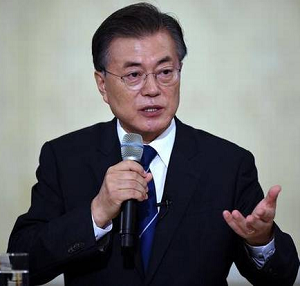
There will be no war on the Korean peninsula, South Korean President Moon Jae-in said on Thursday, saying Seoul effectively had a veto over US military action in response to the North’s nuclear and missile programmes.
Tensions have soared on the peninsula in recent months, with Pyongyang carrying out its first successful tests of an intercontinental ballistic missile (ICBM), bringing much of the US within range.
Last week it threatened to send a salvo of rockets towards the US territory of Guam — although it appears to have backed off for now — while US President Donald Trump promised “fire and fury” and said that Washington’s weapons were “locked and loaded”.
The intense rhetoric on both sides has raised fears of a miscalculation leading to catastrophic consequences — Pyongyang has vast artillery forces deployed within range of Seoul, where millions of people live.
But Mr. Moon said: “I will prevent war at all cost.”
“I want all South Koreans to believe with confidence that there will be no war,” he told a press conference marking his first 100 days in office.
The United States has been the South’s security guarantor since the end of the Korean War in 1953, which left the peninsula divided and technically still in a state of conflict with no peace treaty signed.
Washington has 28,500 troops stationed in the country to protect it from the North.
But Mr. Moon said Seoul effectively had a veto on military action by the US.
Washington and Mr. Trump had agreed that “no matter what option they take about North Korea, all decisions will be made after consulting with and getting agreement with the Republic of Korea.”
Mr. Trump’s rhetoric has raised alarm among observers but Moon, who visited Washington at the end of June, declined to criticise his choice of words.
The US leader was “trying to pressure North Korea by showing a firm resolution”, he said.
He added: “All South Koreans have worked so hard together to rebuild the country from the ruins of the Korean War. We can’t lose everything with another war.”
Red line
Pyongyang says it needs nuclear weapons to defend itself from possible invasion by its “imperialist enemy” the US and has long sought to develop a nuclear-tipped missile capable of hitting the US mainland.
The North has been subjected to seven sets of sanctions by the United Nations Security Council over its nuclear programme, the latest earlier this month, with China, its main ally and benefactor, promising to comply.
Beijing has grown increasingly exasperated with its wayward neighbour, but fears instability and the prospect of US troops on its border in a united Korea.
In the past Mr. Moon, a left-leaning former human rights lawyer, has urged engagement with Pyongyang to bring it to the negotiating table, in addition to sanctions — an approach that raised concerns it could create divisions with Washington.
But since coming to power his gestures have been rebuffed by Pyongyang, and he played down the urgency of dialogue.
“I don’t think we must rush into it,” he said.
For talks to take place, he said, “there must be a guarantee that it will lead to a fruitful outcome.
“North Korea must at least end additional provocations to create the mood for dialogue.”
Only then could Seoul consider sending an envoy to the North, he added.
“The red line would be North Korea completing its ICBM and mounting it with a nuclear warhead and weaponising it,” he added.
“If North Korea launches another provocation, it will face even stronger sanctions and it will not be able to survive them. I would like to warn North Korea to end its dangerous gamble.”
The North’s leader Kim Jong-Un said on Tuesday he would “watch a little more” before making a decision on the Guam missile launch, a declaration Mr. Trump lauded as “very wise”.
But the US and South Korea are set to begin their annual 10-day Ulchi Freedom Guardian joint exercises on Monday, involving tens of thousands of troops, which the North has long slammed as a rehearsal for invasion.
Pyongyang has often staged provocations as a show of force against past military drills, such as missile launches or movements of its arsenal and troops along the tense border.
There Will Be No War On Korean Peninsula, Says Moon

U.S. President Donald Trump disbanded two high-profile business advisory councils on Wednesday after corporate CEOs quit in protest at his remarks blaming violence in Charlottesville, Virginia, not only on white nationalists but also on the protesters who opposed them.
Mr. Trump announced the break-up of the advisory councils after 3M Co’s Inge Thulin became the latest of several chief executives to leave Mr. Trump’s American Manufacturing Council, and the President’s Strategic and Policy Forum broke up of its own will. “Rather than putting pressure on the businesspeople of the Manufacturing Council & Strategy & Policy Forum, I am ending both,” Mr. Trump wrote on Twitter.
A former senior Trump administration official raised the prospect that some White House officials could quit because of Mr. Trump’s comments. “If you have some high-profile individuals leaving, you may have a whole host of high-profile individuals leaving,” said the official. Vice President Mike Pence, who is cutting short a trip to Latin America, said at a news conference in Chile that “I stand with the President and I stand by those words.”
Trump Disbands Two Business Councils
Subscribe to:
Posts
(
Atom
)